We built a lab. The children finished it.
Bayer Pop-Up Lab – Interactive Science Architecture


The Bayer Pop-Up Lab in Bucharest, is a creative and educational architectural installation that transforms container-based space into an interactive science pavilion. Commissioned by the German company Bayer in collaboration with Ogilvy Romania, this dynamic pop-up laboratory was conceived to inspire curiosity and hands-on learning for elementary school students.
A Playful Space for Science and Discovery
Installed in a public park in Bucharest, this temporary educational pavilion rethinks how architecture can host knowledge: light, mobile, disarming. The project transforms three industrial shipping containers into a compact interactive science lab for children, where learning happens through curiosity rather than instruction.
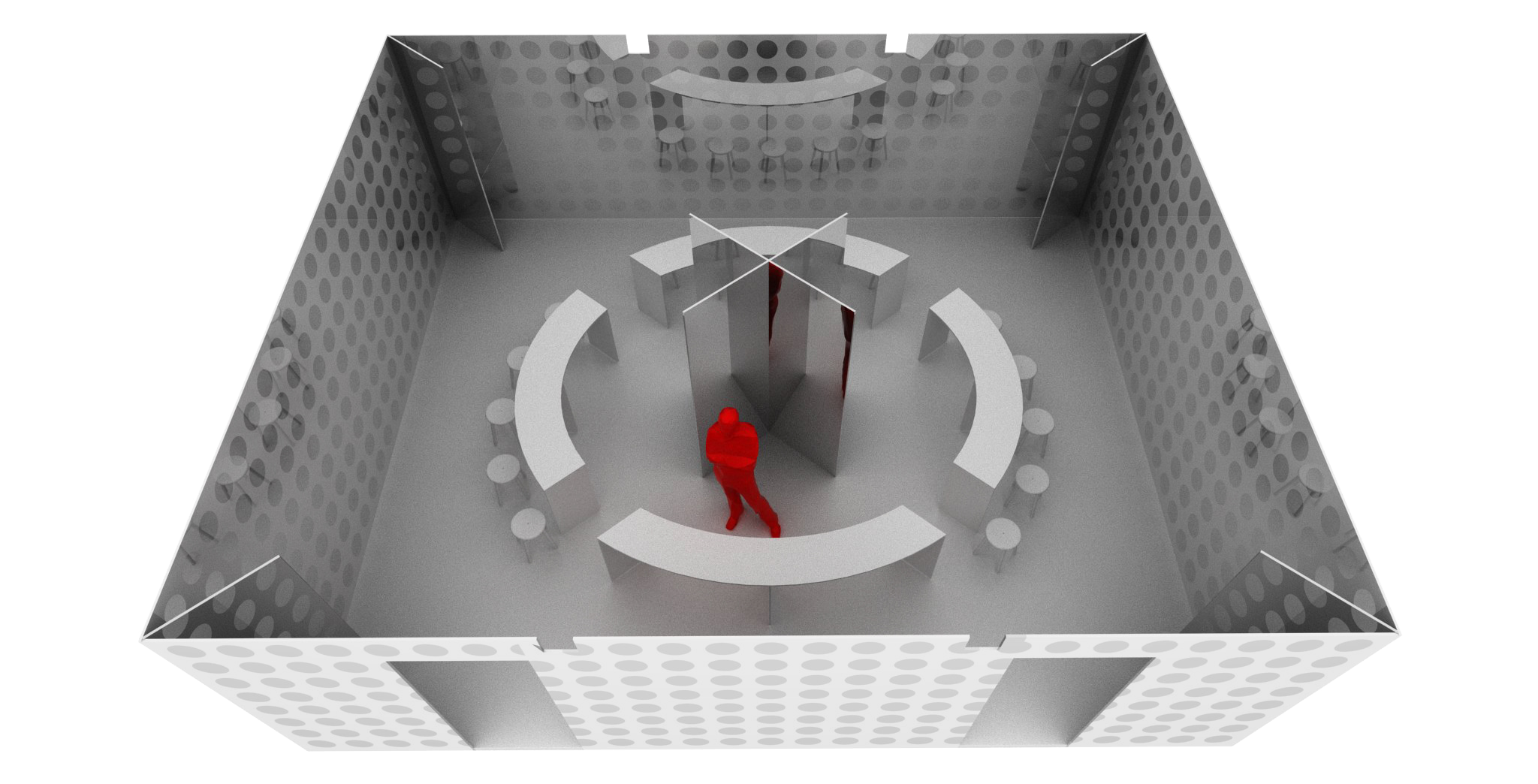
The containers are sliced diagonally, reorganized into four spatial moments: arrival, health, agriculture, and materials. Program becomes movement. Science becomes spatial narrative. At just 50 m², the pavilion proves that scale is irrelevant when architecture is precise.
Architecture as Interaction
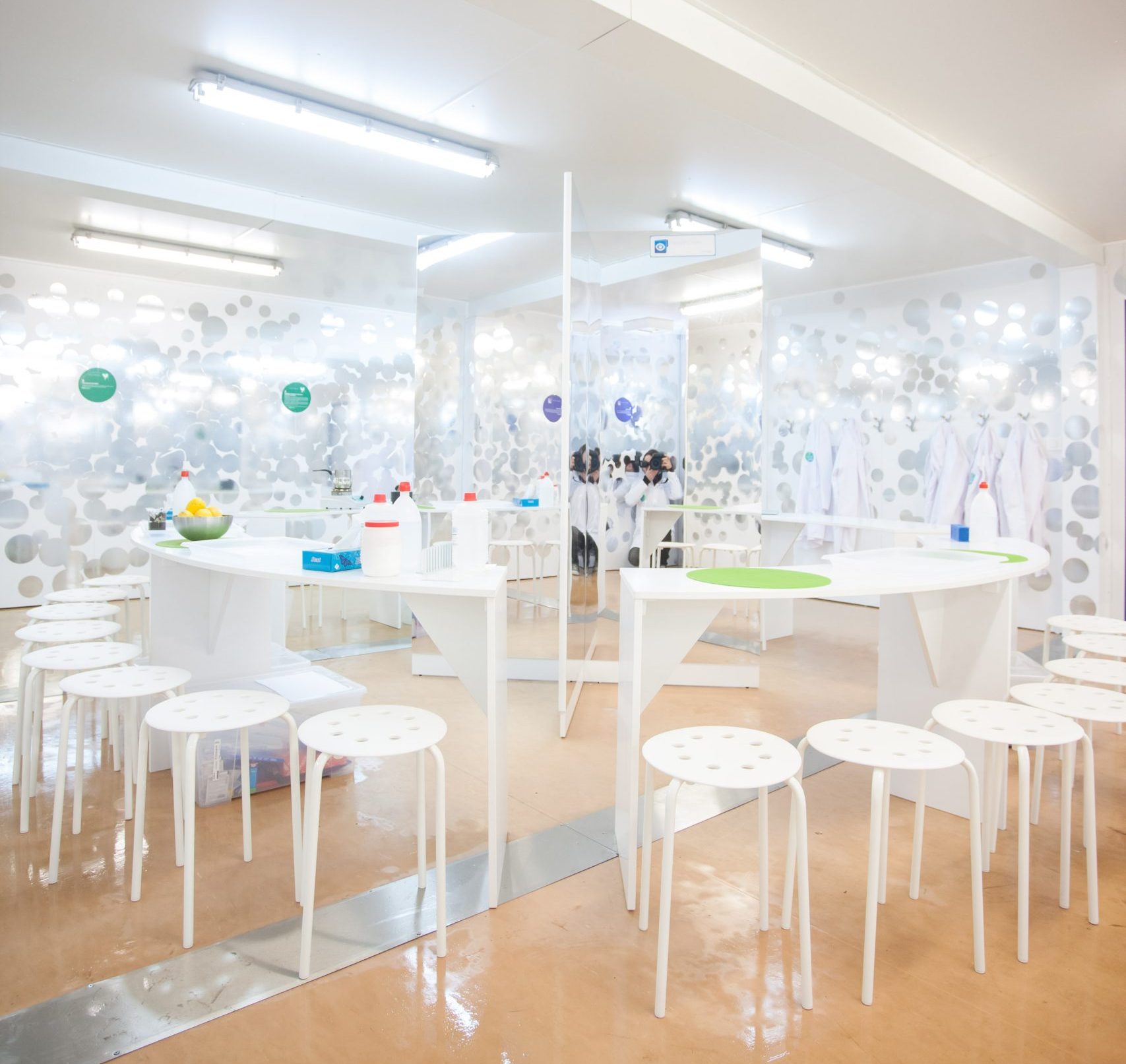
Inside, white MDF panels and mirrored round stickers cover the surfaces, creating a playful kaleidoscope effect. Each child receives a sticker to place freely within the space, gradually transforming the interior into a vibrant constellation of reflections. This evolving environment not only stimulates visual wonder but also symbolizes how scientific exploration expands human potential.
White surfaces dissolve under a constellation of mirrored circular stickers. Each child adds one. The space slowly changes. Reflection multiplies. Knowledge leaves traces. What begins as a clean interior ends as a collective drawing—an architecture authored by its users.
The Bayer Pop-Up Lab operates somewhere between exhibition, classroom, and urban event. It is architecture as a verb: assembling, teaching, disappearing. A reminder that the most powerful buildings are sometimes the ones that refuse permanence.


The Bayer Pop-Up Lab operates somewhere between exhibition, classroom, and urban event. It is architecture as a verb: assembling, teaching, disappearing. A reminder that the most powerful buildings are sometimes the ones that refuse permanence.