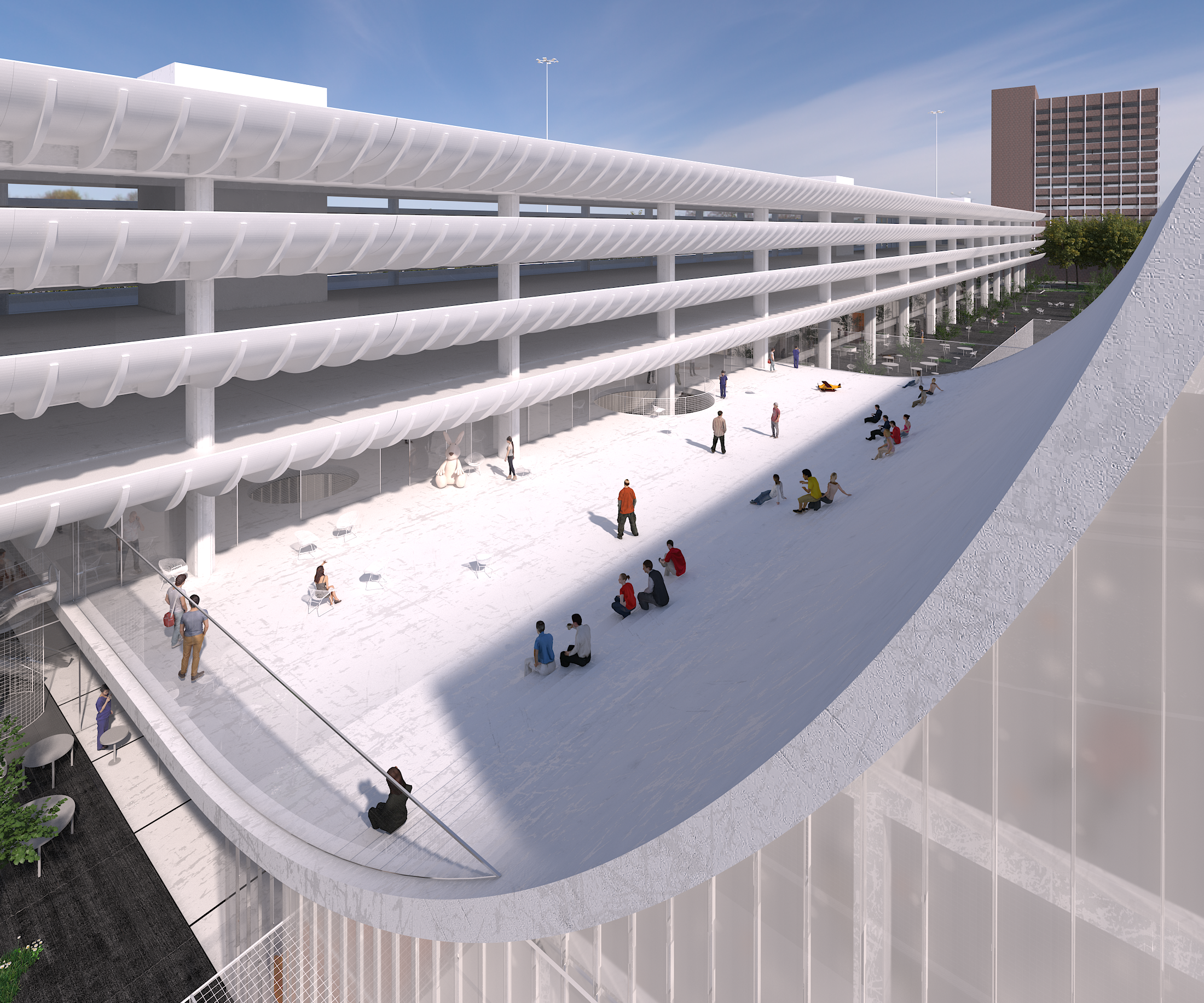
The space reinvents the initial function of connectivity at a local level, connecting the people in different activities and projects.

THE PRESTON BUS STATION
Our strategy for the Preston Bus Station aims to create an entity that can function for the community in the same way the Youth Centre functions for the children: offering a range of cultural and commercial activities that offer the possibility of connecting inside the community or the to achieve some kind of professional potential (art gallery, co-working space). In this way the space reinvents the initial function of connectivity between different cities at a local level, connecting the people in different activities and projects.
The architectural intervention in the bus station will be minimal in order to preserve the unique character of the building. The West side will become an open public space where various pop-up activities can develop. At mezzanine level in the south part a co-working space will be arranged. This space will function in the same logic as the rest of the functions in the core: café/ restaurant, hairdresser etc. At ground floor level, on the south side, there will the coach station.
In order to preserve the purity of the plan there will be no other enclosure of the open space. The space will be furnished with chairs and tables that can be freely used by any of the core functions: as a sitting area for the café, as a working area for the co-working space etc. Also in the week-ends pop-up stores in the form of small stands can be arranged.
In this way the space will reflect the community needs, and will provide a way for the users to choose the activities they want for it.
An art gallery will be functioning in parallel with the rest of the program. The art gallery could function as a contemporary informal extension of the Harris Museum, offering the option of display for the local artists. In special occasions could function together with the Arts and Crafts Informal Area of the Youth Zone, also placed in the existing building, and could display the children’s works. In this way all the community will be connected with the children’s and local artist’s works in a less intimidating, more contemporary set sett than the Harris Museum.
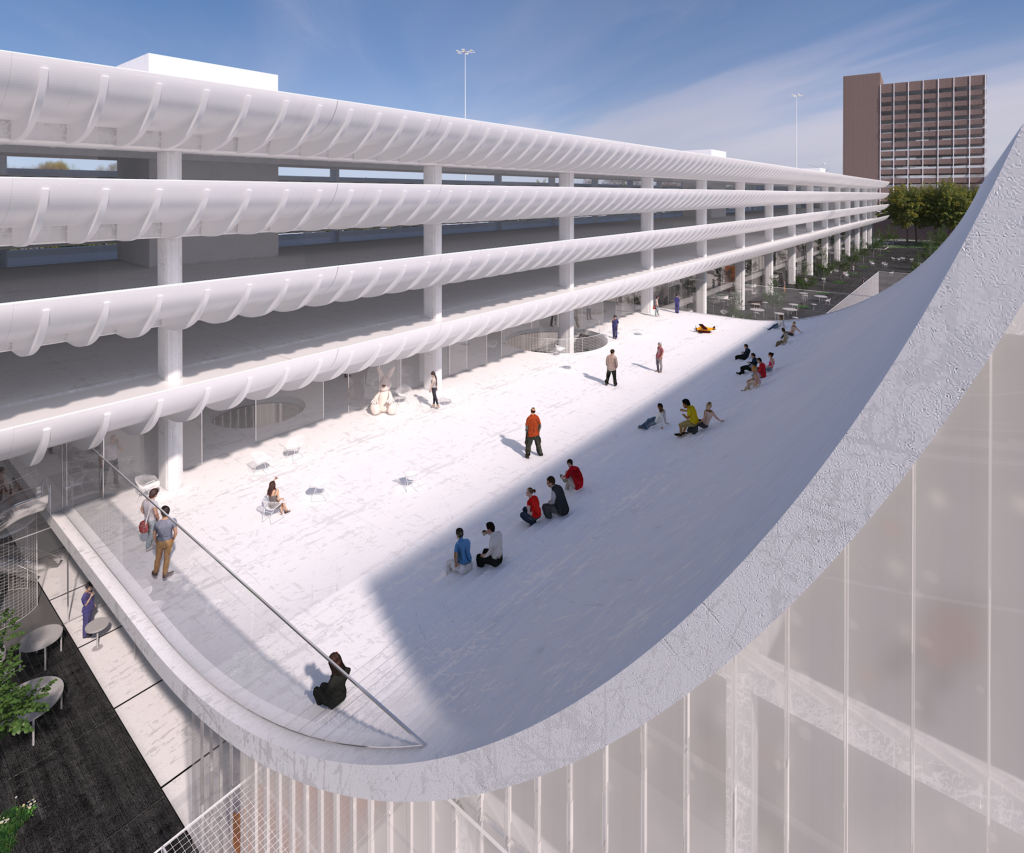
The architectural logic of the Youth zone very simple: we searched for a type of interaction between the old and the new that would not alter the bus station pure lines while still establishing a connection.
We proposed a 2000 m2 curved slab, parallel with the curve of the bus station façade that slides into the existing building at mezzanine level and creates a 500 m2 protected terrace.


THE YOUTH ZONE PLUS
The architectural logic of the Youth zone very simple: we searched for a type of interaction between the old and the new that would not alter the bus station pure lines while still establishing a connection.
We proposed a 2000 m2 curved slab, parallel with the curve of the bus station façade that slides into the existing building at mezzanine level and creates a 500 m2 protected terrace. Three meters height transparent glass parapets will ensure the children’s protection.
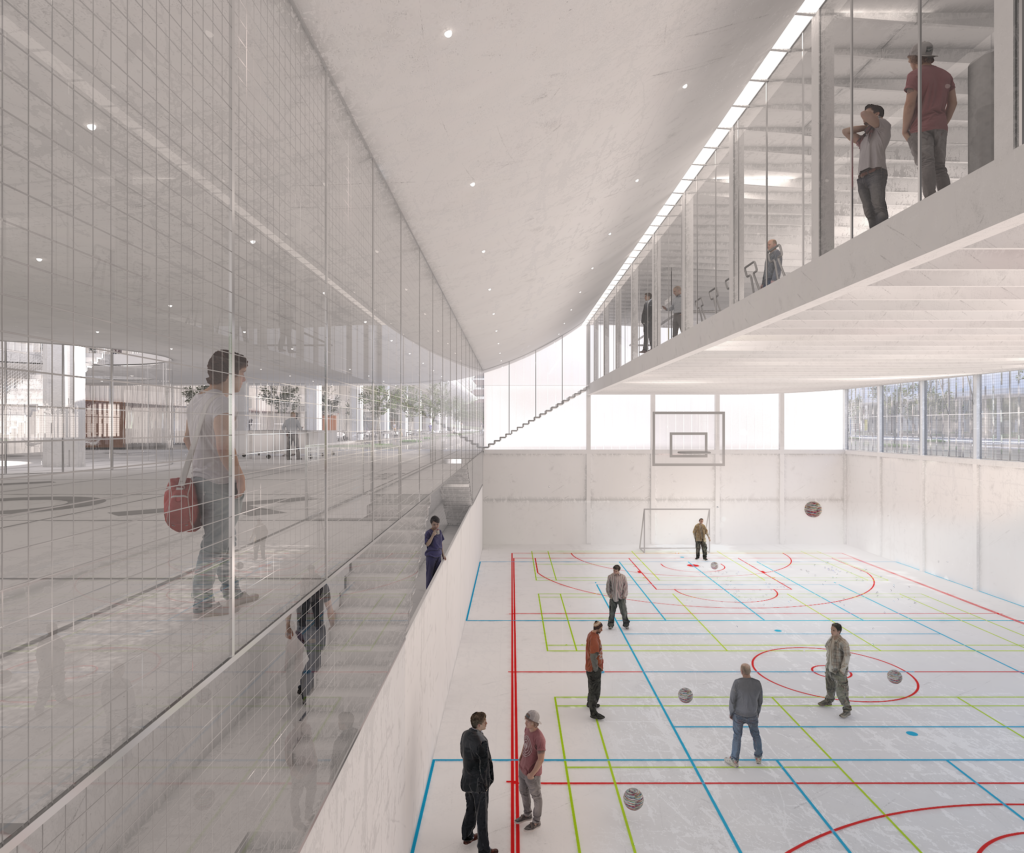
The slab forms a wide open flexible space in the ground floor that can be used as a recreation area but also to host parties and events.
The curved terrace offers a place for the contemplation of the bus station while also opening the Youth Center interior towards the city
The project is developed on three different axes:
–an arts oriented one, in the existing space of the Bus Station. The Informal Arts and Crafts Area could even occasionally extend in the whole eastern half of the Bus Station for public exhibitions of the children’s work.
–The sports axe develops parallel with the arts axe and extends into the park with the exterior Kick Pitch and the Skate Park
–The third axe starts in the ground floor with the other two and develops vertically on floors two and three with Plus Partners Accomodation and the Staff area.
The curved terrace offers a place for the contemplation of the bus station while also opening the Youth Center interior towards the city


A tensile 55 cable system to suspend the 700 concrete façade/roof modules and connect the two buildings
Besides structure, the curved slab will integrate all the systems of the building
STRUCTURAL DESIGN
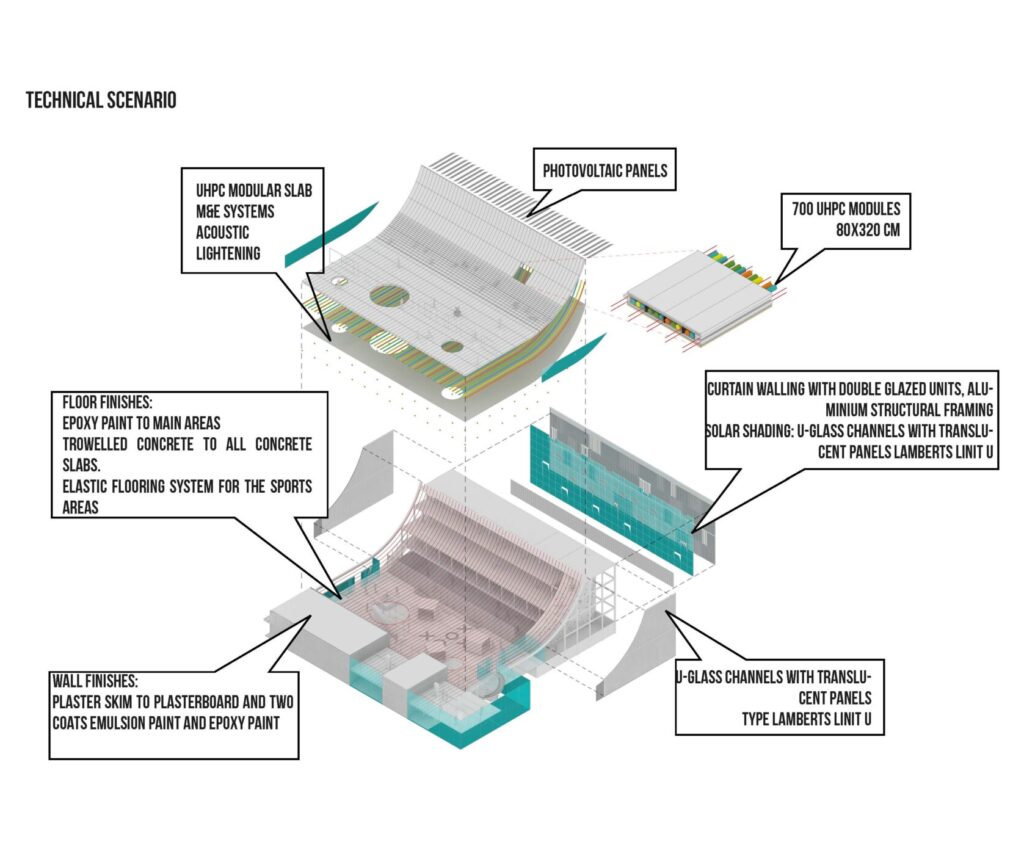
We proposed a structural volume capable of supporting the stresses coming from the curving terrace / roof while floating over the sports hall in the ground floor
The structural design is based on two principles:
-a mixed system for the main body that combines a classic 3,2m column beam grid and a staggered Vierendeel Truss system to float over the sports hall.
-a tensile 55 cable system to suspend the 700 concrete façade/roof modules and connect the two buildings
Besides structure, the curved slab will integrate all the systems of the building: Mechanical, Electrical, data networks, natural ventilation shafts, acoustic layer and lightening. All the building systems will be centralized in the underground under the sports hall locker-rooms and distributed through this curved Slab while being optimized by the BMS to produce the ideal environment.

